
 EN
EN



In the world of coating formulations, achieving consistent and reliable color output is far more complex than simply adding pigment to a base. The science behind how pigment particles are broken down, distributed, and stabilized within a liquid medium determines nearly everything about the final appearance, performance, and durability of a coating. Pigment dispersion is not a secondary step in the manufacturing process — it is the foundational mechanism that governs whether a coating delivers the color it promises, batch after batch, surface after surface.
For formulators, paint manufacturers, and coating technologists, the quality of pigment dispersion directly translates into product competitiveness. Poor dispersion leads to visible defects, color inconsistency, reduced hiding power, and unstable shelf life — all of which damage brand reputation and increase production costs. Understanding why pigment dispersion is so critical, and what happens when it is done right or wrong, is essential knowledge for anyone serious about stable color output in modern coating systems.
The Mechanism Behind Pigment Dispersion in Coatings
How Pigment Particles Behave in a Liquid Medium
Raw pigments exist as aggregates and agglomerates — tightly bonded clusters of primary particles that must be broken apart and individually wetted before they can contribute to color development. The process of pigment dispersion involves three sequential stages: wetting, deaggregation, and stabilization. Each stage must be completed effectively for the final coating to exhibit uniform color and consistent optical properties.
During the wetting stage, the liquid medium must penetrate the voids between pigment particles and displace air from the particle surfaces. Incomplete wetting results in dry agglomerates that resist further breakdown, creating visible specks or grainy texture in the applied film. The energy input required during milling or high-shear mixing is only effective when the wetting chemistry has been properly addressed through surfactant selection and vehicle compatibility.
Deaggregation is the mechanical rupture of these particle clusters into their primary size. This step defines the maximum color strength achievable from a given pigment. When pigment dispersion reaches the primary particle level, the full surface area of each particle is exposed, maximizing light interaction and delivering the intended chroma and tint strength. Insufficient deaggregation leaves color potential untapped and creates inter-batch variation that is difficult to correct downstream.
Stabilization and Its Role in Long-Term Color Consistency
Once particles are separated, they must be prevented from re-agglomerating through a process called stabilization. This is often the most overlooked aspect of pigment dispersion, yet it has the most direct impact on storage stability and application consistency. Without proper stabilization, dispersed particles will flocculate over time, causing color drift, flooding, and floating during application.
Stabilization is achieved through steric or electrostatic mechanisms, depending on the resin system and pigment chemistry involved. In water-based coating systems, electrostatic stabilization using anionic or nonionic dispersants is particularly critical because water is a polar medium that promotes particle interaction and re-agglomeration. The choice of dispersant must be matched to both the pigment surface chemistry and the binder system to achieve durable pigment dispersion stability.
Properly stabilized pigment dispersion systems maintain their particle size distribution over months of storage, ensuring that the coating applied on day one of production performs identically to a batch applied six months later. This temporal stability is non-negotiable in architectural and industrial coating markets where color matching accuracy is a core deliverable.
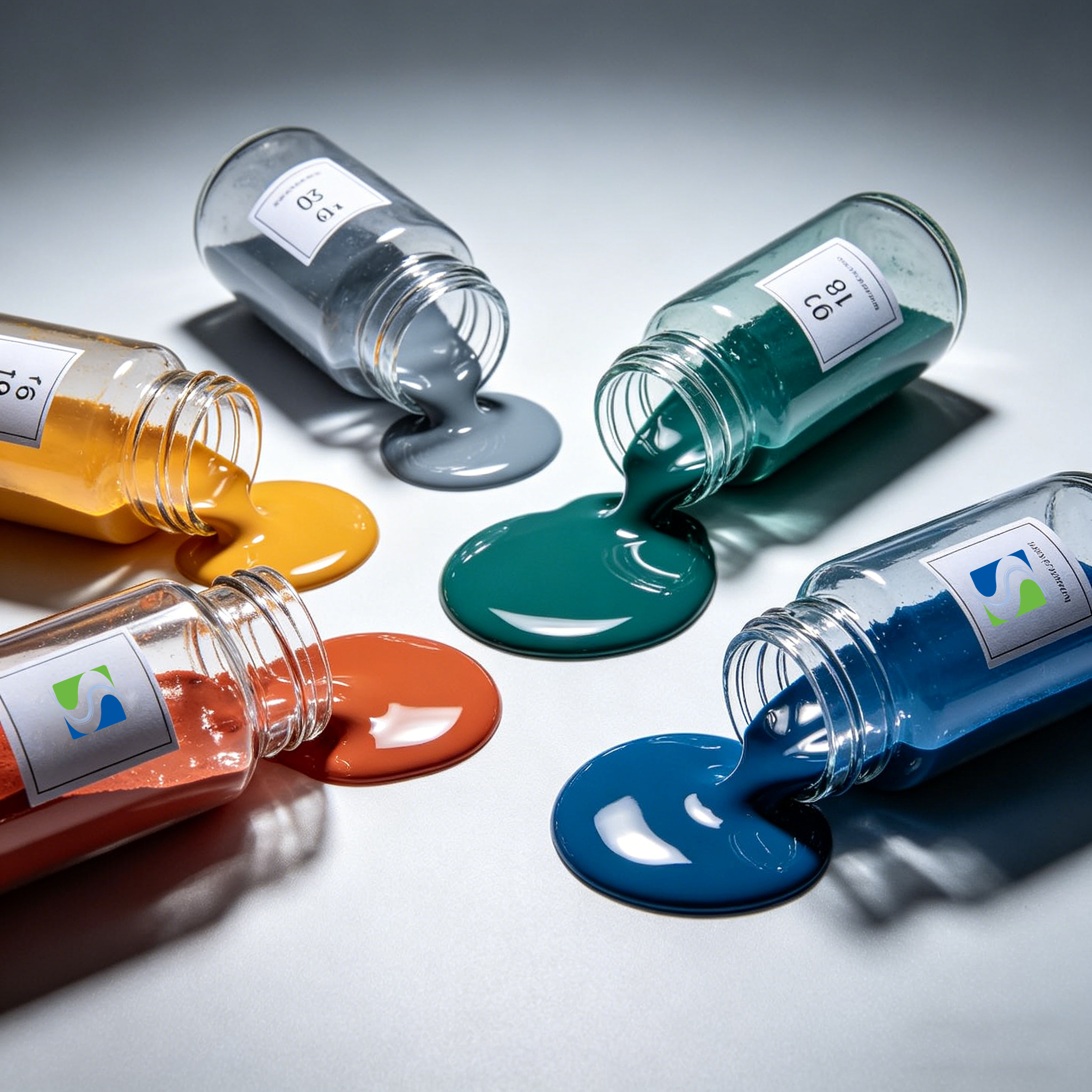
How Pigment Dispersion Quality Affects Stable Color Output
Color Strength, Tinting Power, and Opacity
The relationship between pigment dispersion quality and color strength is direct and measurable. As pigment particles approach their primary size through effective dispersion, the surface area available for light absorption and scattering increases significantly. This translates into higher tinting strength per unit of pigment, which means formulators can achieve target color depth with less pigment loading — a direct cost benefit alongside the performance advantage.
Opacity, or hiding power, is similarly governed by the degree of pigment dispersion. Titanium dioxide, the most widely used white pigment, achieves its maximum hiding power only when dispersed to an optimal particle size range, typically between 200 and 300 nanometers. Over-grinding or under-grinding both reduce opacity. This particle size dependency applies equally to colored organic and inorganic pigments, making controlled pigment dispersion a precision process rather than a purely mechanical one.
In tinting systems used for architectural coatings, the consistency of pigment dispersion in the colorant directly determines whether a tinted formula matches the standard across different base paints and application conditions. pigment dispersion quality in professional water-based colorants is therefore a primary specification criterion, not an afterthought.
Color Uniformity Across Batches and Substrates
Batch-to-batch color uniformity is one of the most demanding quality benchmarks in coating production. Even minor variations in the degree of pigment dispersion between production runs can result in measurable color differences — often expressed as delta E values — that are visible to the naked eye, especially in large-area applications like architectural facades or industrial equipment.
Substrate interaction also plays a role. A coating with unstable pigment dispersion may exhibit different color output on smooth versus porous substrates, because the flocculation behavior of insufficiently stabilized pigments changes under different absorption rates. This means that stable pigment dispersion is not only about what happens inside the can, but also about how the coating behaves at the moment of application and during film formation.
Formulators who invest in high-quality pigment dispersion processes and inputs experience significantly lower color rejection rates, reduced re-tinting labor, and stronger customer satisfaction metrics. The economic argument for prioritizing dispersion quality is as strong as the technical one.
Factors That Compromise Pigment Dispersion in Coating Systems
Formulation Incompatibilities and Dispersant Selection Errors
One of the most common sources of pigment dispersion failure is the mismatch between dispersant chemistry and pigment surface characteristics. Different pigment types — organic, inorganic, transparent, opaque — have different surface energies and polarities that require tailored dispersant structures. Using a universal dispersant across incompatible pigment types is a formulation shortcut that typically results in poor wetting, inadequate particle separation, and rapid post-dispersion flocculation.
Resin-dispersant interactions also introduce complexity. Certain dispersants may compete with the binder for adsorption onto the pigment surface, reducing stabilization efficiency. In high-PVC formulations where pigment and extender loading is significant, dispersant demand increases substantially, and under-dosing creates localized areas of poor pigment dispersion that manifest as color streaking or mottle in the applied film.
Water-based formulations face additional challenges because water's high surface tension resists wetting of hydrophobic pigment surfaces. Achieving effective pigment dispersion in waterborne systems requires not only appropriate dispersants but also co-solvents or coupling agents that bridge the polarity gap between the pigment surface and the aqueous medium.
Process Variables and Equipment Limitations
Even with optimal formulation chemistry, process variables can undermine pigment dispersion outcomes. Mixing speed, temperature, dwell time, and the sequence of ingredient addition all influence the final dispersion state. Insufficient shear energy during the dispersion stage leaves agglomerates intact, while excessive heat during milling can degrade dispersant effectiveness and cause premature flocculation.
Equipment type and condition matter significantly. Bead mills, high-speed dissolvers, and three-roll mills each produce different dispersion profiles depending on the pigment type and vehicle viscosity. Worn milling media, contaminated equipment, or incorrect bead-to-pigment ratios introduce variability that directly impacts color consistency. A rigorous quality control protocol that includes particle size analysis after each dispersion run is essential to detecting these process deviations before they become customer complaints.
Storage conditions after dispersion also affect long-term pigment dispersion stability. Temperature fluctuations during transport or warehousing can disrupt the equilibrium of the stabilization layer, leading to partial flocculation that changes the color output when the product is eventually applied. This is why cold-chain awareness and proper agitation protocols before use are part of responsible dispersion management.
Pigment Dispersion in Water-Based Colorant Systems for Architectural Coatings
Unique Demands of Architectural Coating Tinting
Architectural coating tinting systems operate under demanding conditions that make pigment dispersion performance particularly critical. Point-of-sale tinting equipment dispenses colorants into a wide variety of base paints with differing resin chemistries, PVC levels, and pH values. The colorant must maintain stable pigment dispersion regardless of the base it encounters, and must mix uniformly into the base within seconds of dispensing.
This compatibility requirement means that water-based colorants used in architectural tinting must be formulated with dispersants and co-binders that tolerate a broad range of chemical environments. The pigment dispersion within these colorants must be exceptionally stable — capable of surviving months of storage in dispensing machines without sedimentation, phase separation, or viscosity drift that would alter the dispensed volume and therefore the color accuracy.
Color accuracy at the point of tinting is directly dependent on the stability and uniformity of the colorant's pigment dispersion. A colorant where particles have partially flocculated will dispense less color-active material per pump stroke than a fully dispersed equivalent, creating systematic color deviation across thousands of tinted cans. This is why professional-grade water-based colorants specify particle size distribution, grind fineness, and dispersion stability as primary product attributes.
Performance Benchmarks for High-Quality Pigment Dispersion
Industry benchmarks for effective pigment dispersion in architectural colorants typically include a fineness of grind below 10 microns as measured by a Hegman gauge, particle size distribution data confirming primary particle separation, and stability testing showing less than 5% viscosity change and no visible settling after 30 days at elevated temperature. These metrics provide a quantitative framework for evaluating whether a pigment dispersion will deliver stable color output in real-world tinting scenarios.
Tinting strength consistency is another key benchmark. A well-dispersed colorant should produce a tint strength result within plus or minus 2% of the standard across multiple production batches. Broader variation indicates dispersion inconsistency and will inevitably produce color complaints in the field. Color formulators at major architectural paint companies treat pigment dispersion quality in incoming colorants as a critical raw material specification that triggers supplier evaluation processes when out-of-specification results occur.
Temperature stability testing, freeze-thaw cycling, and mechanical stability under shear are additional performance tests applied to architectural colorants. Each of these tests probes a different aspect of pigment dispersion robustness, and passing all of them is a prerequisite for a colorant to qualify for use in professional tinting systems where color consistency is a commercial commitment.
FAQ
What happens to a coating when pigment dispersion is inadequate?
When pigment dispersion is inadequate, the coating will exhibit a range of visible and functional defects. These include color streaking, mottled or uneven color, reduced hiding power, lower color strength than expected, and potential gloss variation across the applied film. Over time, poorly dispersed coatings may show color drift as flocculated pigment clusters continue to rearrange within the dried film, particularly under UV exposure or temperature cycling.
How does pigment dispersion affect the shelf life of a colorant or tinted coating?
Pigment dispersion quality has a direct and significant effect on shelf life. A colorant or coating with properly stabilized pigment dispersion will resist sedimentation, hard settling, and viscosity increase over its intended shelf period. Conversely, unstable dispersion leads to pigment settling that may be irreversible with standard mixing, effectively making the product unusable and creating waste. Stabilization chemistry — the third stage of the dispersion process — is the primary determinant of shelf life performance.
Is pigment dispersion quality equally important for all coating types?
While pigment dispersion quality matters across all coating types, its criticality varies with the application. High-gloss coatings are especially sensitive because any remaining agglomerates scatter light and reduce gloss. Architectural flat coatings are somewhat more tolerant of moderate dispersion quality because surface texture masks minor defects. However, in tinting systems, transparent coatings, and any application where color matching accuracy is a deliverable, high-quality pigment dispersion is non-negotiable regardless of the sheen level.
Can pigment dispersion quality be improved after the initial manufacturing stage?
To a limited extent, yes, but post-manufacturing correction of pigment dispersion is costly and imprecise. Re-grinding or re-milling a finished coating risks introducing contamination, altering viscosity, and damaging stabilizer layers. The most reliable approach is to achieve target pigment dispersion quality during the initial manufacturing process through proper formulation design, correct dispersant selection, and validated process parameters. Relying on downstream correction as a quality strategy is both economically inefficient and technically unreliable.
Table of Contents
- The Mechanism Behind Pigment Dispersion in Coatings
- How Pigment Dispersion Quality Affects Stable Color Output
- Factors That Compromise Pigment Dispersion in Coating Systems
- Pigment Dispersion in Water-Based Colorant Systems for Architectural Coatings
-
FAQ
- What happens to a coating when pigment dispersion is inadequate?
- How does pigment dispersion affect the shelf life of a colorant or tinted coating?
- Is pigment dispersion quality equally important for all coating types?
- Can pigment dispersion quality be improved after the initial manufacturing stage?