
 EN
EN


In rubber product manufacturing, achieving consistent and uniform color distribution is far more than a cosmetic concern. The question of whether a colorant can genuinely optimize dispersion is one that engineers, formulators, and production managers grapple with regularly. Poor dispersion leads to streaking, uneven pigmentation, and compromised mechanical properties — all of which translate into costly rejections and rework on the production floor.
The short answer is yes — the right colorant, properly selected and integrated, can play a decisive role in improving dispersion throughout the rubber compounding process. However, the mechanism is nuanced and depends on the colorant format, its chemical compatibility with the rubber matrix, and the processing conditions involved. This article explores the specific ways colorant selection and design influence dispersion quality in rubber manufacturing, giving you practical insight to make better formulation decisions.
Understanding Dispersion Challenges in Rubber Manufacturing
Why Dispersion Is Critical in Rubber Compounding
Rubber compounding is a complex process that combines a base polymer with fillers, plasticizers, vulcanizing agents, and colorants. Each additive must be evenly distributed throughout the rubber matrix to ensure product consistency and performance. When any component — including a colorant — fails to disperse uniformly, it creates weak points in the final article that can lead to premature failure or surface defects.
Dispersion quality is evaluated by how finely and evenly pigment particles are distributed within the rubber compound before and after vulcanization. Agglomerated pigment particles act like stress concentrators, reducing tensile strength and elongation at break. For products like seals, gloves, tubing, or automotive components, these micro-failures carry serious consequences in terms of product lifespan and safety compliance.
A well-chosen colorant does not merely impart color — it interacts with the compound's rheology. Its wetting behavior, particle surface chemistry, and viscosity profile all influence how thoroughly it integrates into the surrounding matrix during mixing. This is why colorant selection has a direct bearing on dispersion outcomes, not just aesthetic results.
Common Dispersion Problems Linked to Colorant Format
Dry pigment powders, though widely used historically, are notorious for presenting dispersion difficulties. Their tendency to form agglomerates during storage and processing means that significant mechanical energy is required to break them down during mixing. Even with extended milling, residual particle clusters can remain embedded in the rubber, creating visible speckling or inconsistent hue across the product surface.
Pre-dispersed colorant formats, such as masterbatches or liquid colorant concentrates, were developed specifically to address these limitations. By pre-wetting pigment particles in a carrier compatible with the target rubber system, manufacturers can introduce a colorant that is already partially dispersed before it enters the mixer. This dramatically reduces the energy and time needed to achieve homogeneous distribution.
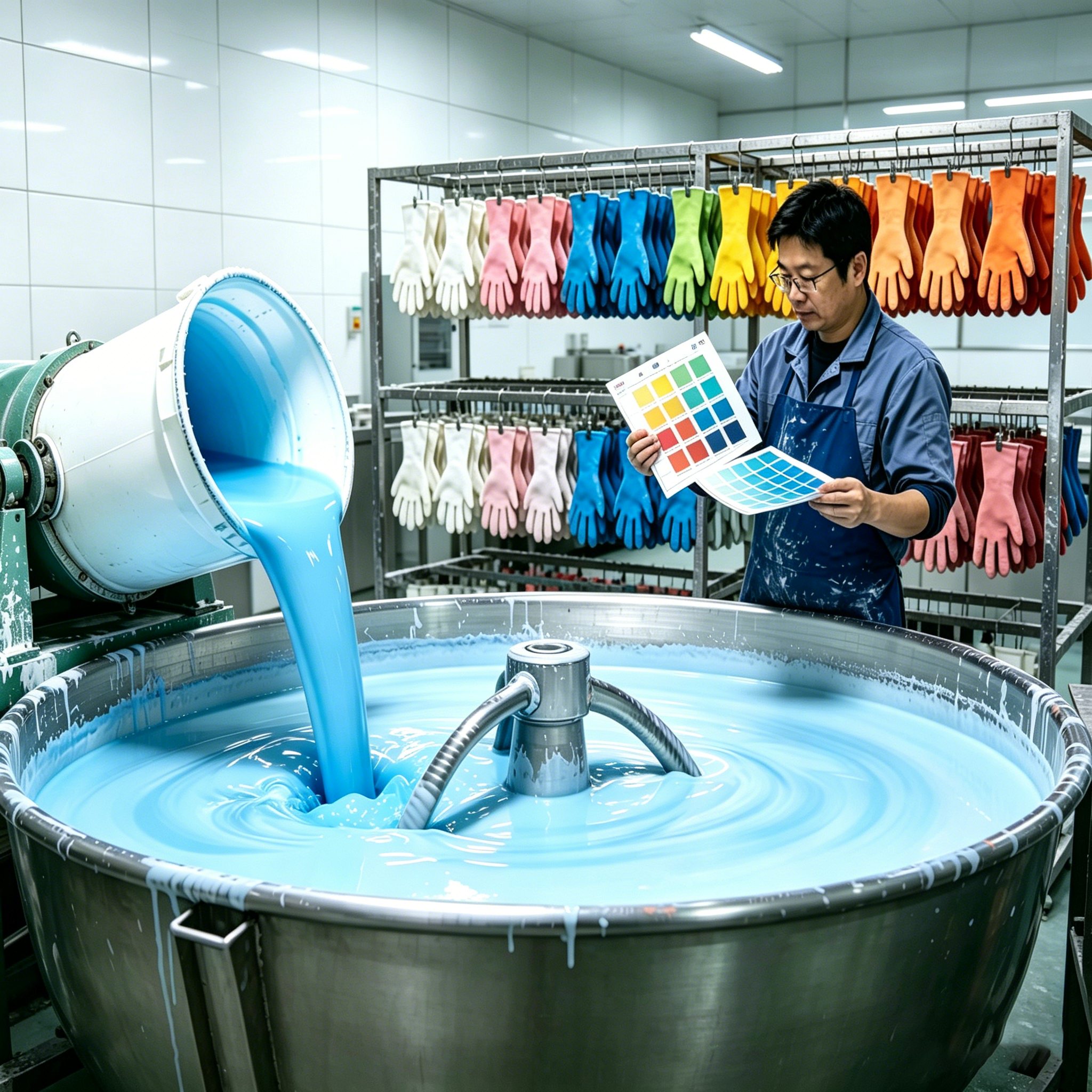
Water-based liquid colorants represent a particularly efficient format for latex and certain synthetic rubber applications, as the aqueous phase facilitates rapid and even integration. The colorant carrier itself can contribute to the overall dispersion quality by reducing surface tension at the pigment-polymer interface, enabling particles to spread more readily throughout the matrix.
How Colorant Chemistry Influences Dispersion Behavior
Particle Size and Surface Treatment
The physical and chemical attributes of a colorant are primary determinants of its dispersibility. Pigment particle size is perhaps the most direct variable: finer particles have a greater surface area relative to their volume, which can either assist or hinder dispersion depending on the surface energy involved. Manufacturers of high-quality colorants apply surface treatments to pigment particles specifically to improve their wetting and reduce the tendency to re-agglomerate under shear conditions.
Surface-treated pigments exhibit a modified outer chemistry that enhances their affinity for the rubber matrix. This means that once separated during mixing, the particles are less likely to cluster again as the compound cools or rests. The result is a more durable and even dispersion that holds its integrity through subsequent processing steps like calendering, extrusion, or molding.
For rubber manufacturers, selecting a colorant that specifies its pigment particle size distribution and surface treatment methodology is a practical quality assurance step. Suppliers who can provide this technical data are generally offering a product engineered for predictable dispersion performance, rather than a generic pigment preparation.
Carrier Compatibility and Rheological Effects
Beyond the pigment itself, the carrier medium of a colorant plays a substantial role in dispersion optimization. In rubber applications, the carrier must be compatible with the polymer matrix without introducing adverse effects on vulcanization kinetics or physical properties. An incompatible carrier can migrate to the surface, disrupt crosslink formation, or create adhesion problems in bonded assemblies.
A carefully formulated colorant uses a carrier whose polarity and viscosity are matched to the intended rubber type. For natural rubber or neoprene compounds, different carrier formulations will yield very different dispersion outcomes. The carrier effectively 'lubricates' the colorant particles during mixing, allowing them to shear apart and wet the surrounding polymer chains more efficiently.
Rheological compatibility also affects how the colorant behaves during high-shear mixing on internal mixers or open mills. A colorant with optimized flow characteristics will distribute itself evenly during the early stages of mixing, before the compound develops its full viscosity, which is the window of opportunity when dispersion is easiest to achieve. Poor rheological matching leads to uneven incorporation and can force operators to extend mixing cycles, increasing thermal exposure and energy consumption.
Colorant Format Optimization for Specific Rubber Applications
Liquid Colorants in Latex and Foam Applications
Latex rubber systems present unique dispersion challenges because the compounding occurs in an aqueous colloidal environment rather than a dry polymer melt. In this context, a water-based liquid colorant is the natural format of choice. It integrates into the latex without disrupting the colloidal stability of the compound and ensures that pigment particles are distributed throughout the liquid matrix before film formation or gelation occurs.
The dispersion efficiency of a water-based colorant in latex is particularly influenced by its surfactant system. Colorants designed for latex use incorporate carefully balanced dispersants that prevent pigment settling during storage and promote even distribution throughout the latex compound during the dipping or casting process. The result is a uniform color appearance in the final film or foam product, with no mottling or color variation between batches.
For products such as latex gloves, balloons, foam mattresses, or coated textiles, achieving consistent colorant dispersion is directly linked to product aesthetics and consumer perception. A colorant that cannot maintain stable dispersion in a latex system will produce visually unacceptable results regardless of its nominal pigment quality.
Masterbatch Colorants in Solid Rubber Processing
In solid rubber processing — whether natural rubber, EPDM, SBR, or silicone — masterbatch-format colorants offer significant dispersion advantages over dry powder alternatives. A rubber masterbatch pre-disperses pigment in a rubber carrier compound, typically using intensive mixing equipment. When this masterbatch is added to the main compound, the pigment is already broken down to its optimum particle size and is surrounded by compatible polymer, making re-dispersion into the base compound far more efficient.
The use of a masterbatch colorant also reduces the number of individual weighing and handling steps on the production floor, minimizing contamination risks and dosing errors. Since the pigment loading in a masterbatch is controlled during its manufacture, the end-user benefits from a more consistent and reliable colorant addition each production run.
Masterbatch colorants can be formulated with specific rubber polymer carriers that mirror the base compound type, further improving compatibility and dispersion kinetics. This level of formulation customization is one of the key reasons that technically advanced rubber manufacturers increasingly specify masterbatch or pre-dispersed colorant formats over conventional pigment powders.
Practical Strategies for Maximizing Colorant Dispersion Efficiency
Mixing Sequence and Process Optimization
Even the most well-engineered colorant can underperform if introduced at the wrong stage of the mixing cycle. Best practice in rubber compounding dictates that colorants should generally be added after the base polymer has been plasticized and primary fillers have been incorporated. At this stage, the compound has developed sufficient heat and internal friction to facilitate colorant dispersion without the risk of premature decomposition of heat-sensitive pigment types.
The mixing temperature also matters significantly. Certain organic pigments used in colorant formulations begin to migrate or bleed if exposed to excessively high compound temperatures. Specifying a colorant rated for the peak mixing temperatures of your process — and confirming its heat stability data with the supplier — prevents dispersion gains from being undermined by thermal degradation at the processing stage.
Optimizing the dump temperature and mix time based on the specific colorant format being used is a practical step that production engineers can take to improve dispersion outcomes without changing the colorant itself. Minor adjustments in rotor speed or mixer fill factor can also create the additional shear needed to fully break down colorant agglomerates for applications with demanding color consistency specifications.
Quality Control Methods to Verify Dispersion
Once the colorant has been incorporated, verifying dispersion quality is essential for maintaining product standards. Visual inspection under magnification can reveal surface pigment agglomerates in cured rubber sheets or extruded profiles, but more sophisticated methods are available for critical applications. Colorimetric measurement using spectrophotometers allows manufacturers to track batch-to-batch color consistency and detect dispersion variations before products move to final assembly or packaging.
For applications where colorant dispersion affects mechanical performance — such as in medical rubber components or high-specification automotive seals — microscopic analysis of cross-sections can reveal the presence of undispersed pigment particles and their distribution within the compound. This data supports root-cause analysis when dispersion problems arise and helps engineers refine either the colorant specification or the processing parameters accordingly.
Establishing clear acceptance criteria for colorant dispersion as part of the incoming material qualification process is a proactive quality measure. Working with colorant suppliers who can provide certificate-of-analysis data on dispersion particle size, tinting strength, and viscosity ensures that variation is identified at the raw material stage rather than after costly compounding runs.
FAQ
Does the type of rubber polymer affect how well a colorant disperses?
Yes, the base polymer has a significant influence on colorant dispersion. Different rubber types — such as natural rubber, EPDM, silicone, or neoprene — have varying polarities and viscosity profiles that interact differently with colorant carriers and pigment surfaces. Selecting a colorant formulated specifically for the target polymer type is the most direct way to ensure compatibility and optimize dispersion within that rubber system.
Can using the wrong colorant affect the mechanical properties of a rubber product?
An incompatible or poorly dispersed colorant can negatively impact mechanical performance. Agglomerated pigment particles act as stress concentration points, potentially reducing tensile strength, tear resistance, and elongation at break. Additionally, an incompatible carrier can interfere with vulcanization chemistry, leading to under-cure or uneven crosslink density in the finished product. Choosing a technically qualified colorant is therefore as much a functional decision as an aesthetic one.
How do water-based colorants compare to dry pigment powders for dispersion in latex rubber?
Water-based liquid colorants are generally far superior to dry pigment powders for latex applications. Dry powders are difficult to wet into an aqueous latex compound and tend to form agglomerates that persist in the final film or foam. Water-based colorants are pre-dispersed in an aqueous system with surfactants that facilitate integration into the latex matrix, resulting in more uniform color distribution, better batch consistency, and reduced risk of surface defects.
What information should I request from a colorant supplier to evaluate dispersion performance?
When evaluating a colorant for rubber manufacturing, request technical data including pigment particle size distribution, surface treatment methodology, carrier chemistry and compatibility data for your specific rubber type, heat stability rating, and recommended dosage range. Asking for dispersion test results or application trials in a compound similar to your own provides the most relevant evidence. Suppliers who can offer this level of documentation are typically those whose colorant products are designed for professional industrial use rather than general-purpose applications.
Table of Contents
- Understanding Dispersion Challenges in Rubber Manufacturing
- How Colorant Chemistry Influences Dispersion Behavior
- Colorant Format Optimization for Specific Rubber Applications
- Practical Strategies for Maximizing Colorant Dispersion Efficiency
-
FAQ
- Does the type of rubber polymer affect how well a colorant disperses?
- Can using the wrong colorant affect the mechanical properties of a rubber product?
- How do water-based colorants compare to dry pigment powders for dispersion in latex rubber?
- What information should I request from a colorant supplier to evaluate dispersion performance?